

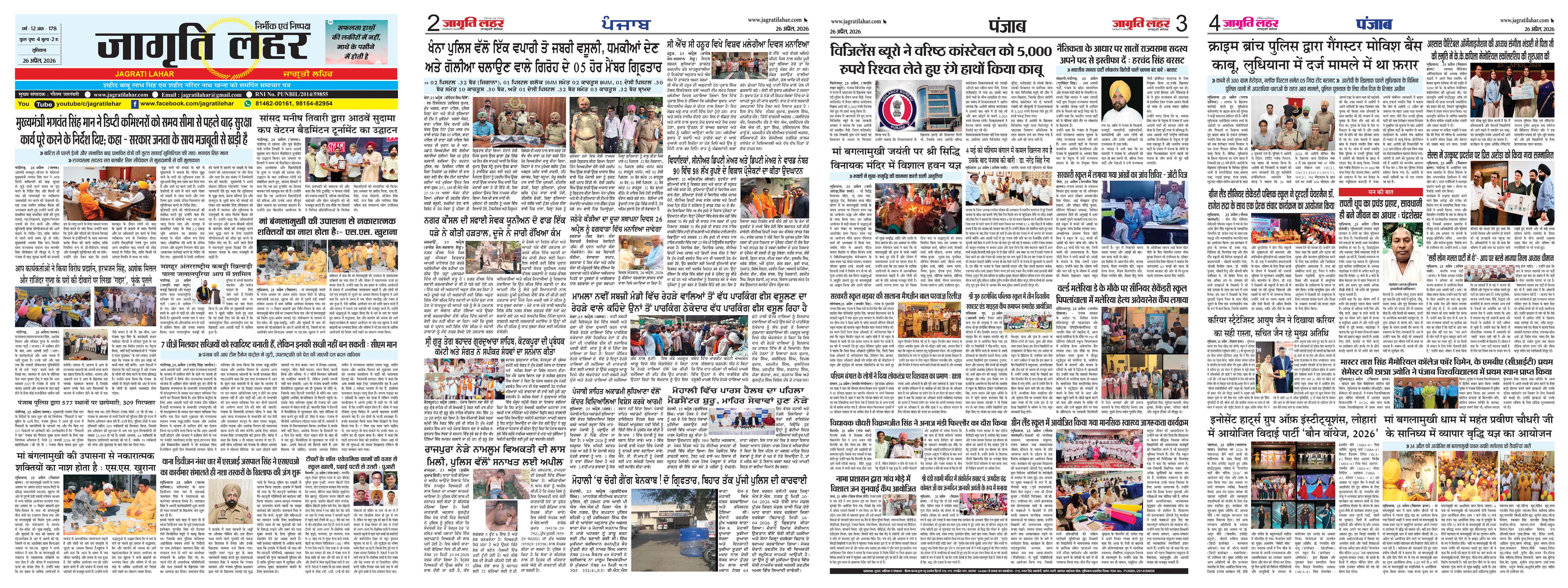



Prof. Sarchand Singh Khiala
Prime Minister Narendra Modi’s speech from the ramparts of the Red Fort on August 15 was not merely an account of the government’s achievements. It also drew the nation’s attention to several serious challenges concerning India’s internal security, national integrity and future. Among these, the issue of Naxalism holds particular significance.
In this context, the term ‘Dimaagi Naxal’ used by the Prime Minister was viewed by some merely as a ‘political label’. But before objecting to the term ‘Dimaagi Naxal’, it is necessary to ask what threat the Prime Minister was pointing towards.
The Prime Minister clearly stated that armed Naxalism in the forests has been eliminated, but the influence of Maoist thinking—the ‘Dimaagi Naxal’—has not yet been completely eradicated. He specifically drew attention to the fact that for years, people influenced by Naxalist ideology remained present as advisers in the corridors of power and in government committees and influenced policies. To describe this point merely as an attempt to call dissent Naxalism would be to limit the original meaning of the Prime Minister’s statement.
Naxalism was not merely about the gun. If Naxalism is confined only to armed cadres moving through forests with weapons, it would be a major mistake to understand its ideological structure.
The strength of any violent ideology does not lie merely in its weapons. Behind it are ideas, recruitment mechanisms, propaganda, financial support, organisation, communication and networks that create influence within society.
Therefore, the Prime Minister’s warning about the ideological legacy of Naxalism alongside armed Naxalism should be viewed as a serious national security concern.
Here, an important distinction must also be made. Not every person who criticises a government, and not every form of dissent, is Naxalism. But a person who knowingly provides ideological, financial, organisational or other forms of support to violent Maoist ideology, its networks or violent activities cannot simply be dismissed as a ‘critic’. That would not do justice to national security.
‘Naxalism’—India’s Biggest Internal Security Threat
For the new generation, it is important to know that the reach of Naxal influence had, at one point, extended to nearly one-third of the country. The then Prime Minister of the country, Dr Manmohan Singh, had also acknowledged Naxalism as the biggest threat to India’s internal security.
At one time, the challenge had become so serious that the Constitution and democracy were rejected as a “bourgeois structure”, while their existence was reduced to the realm of paper, and the legitimacy of elected governments was challenged. Attempts were made to seek solutions to issues through the bullet of a gun.
But the reality was that the dream of revolution through the barrel of a gun was never the real need of tribal society, nor was it a spontaneous model of tribal rebellion. The claim was to fight for the rights of forest-dwelling and tribal communities, but on the ground, their violent strategy deprived these regions of development.
The precariousness of conditions in rural and tribal areas could be gauged from the fact that after evening, ordinary people often became fearful of stepping outside their homes. At that time, not only was the development of roads and basic infrastructure stalled and the reach of the government machinery weakened, but roads and infrastructure themselves remained targets. Numerous schools were burnt, forcing two generations to remain deprived of education. This ideology gave local people neither economic prosperity nor social justice; it gave them only destruction.
Therefore, it would also be unjust to the millions of people who suffered the pain of its violence to view Naxalism merely as an ideological debate.
Congress-era Silence vs Modi Government’s Resolve
Here, it is also necessary to ask how seriously the Congress governments at the Centre dealt with Naxalism when it was continuously expanding in the country. How did Naxalism strengthen its roots in several states during the long period of Congress rule? Why, on many occasions, was the problem not addressed with the seriousness and determination that it required? Whether the reasons were political calculations, administrative weakness or ideological sympathy, the fact remains that Naxalism was given a long period of time and space to grow and flourish.
In contrast, the government led by Narendra Modi viewed Naxalism as both a national security and a development issue. Prime Minister Narendra Modi and Union Home Minister Amit Shah made a clear resolve to eradicate Maoist Naxalism from its roots by March 31, 2026. This was not merely a political announcement, but a clear expression of the state’s firm political will.
The biggest achievement of the Modi government in tackling Naxalism is that it was not treated merely as a ‘law and order’ problem, but efforts were made to address it by linking security, development and national unity. Alongside strong security operations, a strategy was adopted to expand development into affected areas. Emphasis was also placed on expanding access to roads, communication, education, healthcare and government services.
As a result, both the geographical spread and influence of Naxal violence declined rapidly. The direct beneficiaries were ordinary citizens who had been living under the shadow of violence for decades.
Against this background and context, Prime Minister Modi’s reference to ‘Dimaagi Naxal’ needs to be understood in its proper sense. His warning makes it clear that defeating the gun is not enough; it is also necessary to understand the influence of the ideology that justifies the gun.
The Prime Minister also said that such elements continue to look for opportunities to spread violence and anarchy in the country and may adopt various methods to take society in the wrong direction. That is why he called for identifying and isolating such elements.
This appeal should not be interpreted as support for suppressing legitimate dissent. The question is where dissent ends and where the active promotion or assistance of a violent ideology begins.
The Distinction Between Dissent and Anarchy Is Essential
It must be equally clear that democracy provides space for dissent. Criticising the government, questioning policies or protesting peacefully does not make anyone a Naxal. This distinction must remain clear.
In a democracy, there is a right to criticise the government, but an attempt to push the country towards violence and anarchy cannot be described as freedom of thought. At the same time, elements that justify violence, assist violent organisations, push young people towards violent paths or promote organised anarchy must be dealt with firmly. It is the responsibility of the state to do so.
Therefore, while discussing the term ‘Dimaagi Naxal’, we must move beyond its political interpretation and understand the actual context of the threat to which the Prime Minister has pointed.
Defeating Naxalism does not merely mean eliminating guns from the forests. It means challenging the ideology that considers violence a means of bringing about change. Therefore, Prime Minister Narendra Modi’s warning in this matter needs to be understood in the larger context of national security rather than being dismissed merely as a political attack.
India has travelled a long and difficult road in its fight against Naxalism. Pushing back the power of the gun is a major achievement. It is now equally important to ensure that violent ideology does not once again take root in the minds of the new generation.
It is in this context that another important aspect of Prime Minister Modi’s message concerns the youth. The greatest strength of any violent ideology lies in influencing young minds. Therefore, Naxalism cannot be completely eliminated merely through security operations. It is equally important to connect young people with education, employment, opportunities and the mainstream of development.
That is why the Prime Minister has emphasised protecting young people from such influences and connecting them with the mainstream of building a developed India. This would be the real victory of any democratic state—when young people choose education, skills, democratic institutions and constitutional means, rather than the gun, to make their voices heard.
National security and democracy are not opposed to each other. Strong security protects democracy, while a strong democracy takes away the ground on which violent ideologies thrive.
In such matters, the basis for action should not be an individual’s views, but his or her proven role, intent and actions under the law.
Therefore, let there be a debate on ‘Dimaagi Naxal’—but in the full context. No violent ideology that plays with the unity, integrity and security of the country should receive any ideological or political protection.
Remember: Defeating the gun is a victory for security; defeating the thinking that justifies the gun is a victory for nation-building.
(Prof. Sarchand Singh Khiala, BJP Punjab Spokesperson, 9781355522)
-dimaaginaxal-naxalism-nationalsecurity-maoistideology-indiasecurity





Jagrati Lahar is an English, Hindi and Punjabi language news paper as well as web portal. Since its launch, Jagrati Lahar has created a niche for itself for true and fast reporting among its readers in India.
Gautam Jalandhari (Editor)



 RSS FEED