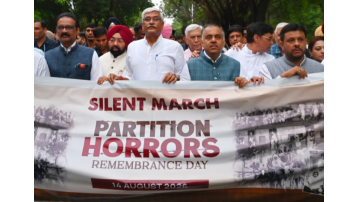
A Nation That Does Not Know Its History And Does Not Take Pride In It Can Never Have A Golden Future: Gajendra Singh Shekhawat
Aug14,2026
| Jagrati Lahar Bureau | Chandigarh
Two crore Indians displaced in the horrors of Partition, 20 lakh killed, five lakh daughters of India subjected to rape: ChughHindus, Sikhs, Jains and Buddhists were 24 per cent of the population in the territory of Pakistan and Bangladesh at the time of Partition, today barely 2 per cent — does anyone have an answer: Chugh
The Nehru-Liaquat Pact bound India and absolved Pakistan of every accountability, the accountability of Nehru's descendants must now be fixed: Chugh
Maa Bharati will never again be allowed to be divided at any cost, this is the truest tribute to the sacrifice of crores of families: Chugh
Chandigarh/Amritsar, August 14, 2026
Bharatiya Janata Party National General Secretary and Rajya Sabha MP Tarun Chugh today addressed the special observance programme held on the occasion of Partition Horrors Remembrance Day at the Golden Jubilee Auditorium, Guru Nanak Dev University, Amritsar. Union Minister of Culture and Tourism Shri Gajendra Singh Shekhawat was present as the Chief Guest, while Rajya Sabha MP Dr. Vikramjit Singh Sahney and Rajya Sabha MP Dr. Ashok Kumar Mittal were also present on the occasion.
Speaking as the Chief Guest on the occasion, Union Minister of Culture and Tourism Shri Gajendra Singh Shekhawat said that a nation which does not know its history, does not understand it and does not take pride in it can never have a golden future, and it was for this reason that Prime Minister Narendra Modi placed in the national memory a chapter that some had tried to bury under the soil so that their truth would never reach today's generation. He said the chain of events from the Lahore Resolution of 1940 to Direct Action Day on 16 August 1946 pushed the country into the fire of communal violence, and that those who had dreamt of power for themselves got power, while those who had dreamt of freedom were made to pay in blood, displacement and the loss of their families. He said that in that hour of darkness, when lakhs arrived by train at refugee camps with nothing but uncertainty ahead of them, the swayamsevaks of the Rashtriya Swayamsevak Sangh stood with society in a spirit of service, which remains the truest mark of India's social character. He said it was the resolve of Sardar Patel that integrated the princely states and gave India its present form, and that today, after the abrogation of Article 370 under the leadership of Prime Minister Narendra Modi, Jammu and Kashmir stands fully joined with the national mainstream. He said the India of today walks with heritage and development together, and urged all those present to ensure that their children are taught the true history of Partition, because only a correct understanding of history will give the coming generation the direction to build a secure, prosperous and developed India by 2047.
In his address Tarun Chugh said the greatest resolve that must emerge from the memory of Partition is that Maa Bharati will never be allowed to be divided again. He said that by declaring 14 August as Partition Horrors Remembrance Day, Prime Minister Narendra Modi gave a place in the national memory to the suffering of crores of families that had been deliberately forgotten for decades.
Tarun Chugh said that the horrors of Partition displaced nearly two crore Indians, took the lives of around 20 lakh people, and subjected more than five lakh daughters of India to rape and humiliation, yet a tragedy of this scale was compressed into a single line in history textbooks for decades. He said that while the Two-Nation Theory laid the ideological foundation of Partition, the role of the Congress leadership of that time cannot be avoided by placing the entire blame on Jinnah and the Muslim League alone. He said Pandit Nehru was part of the top Congress leadership at the time and played a decisive role in the entire process of the transfer of power, which makes it natural to ask whether the political priority of acquiring power immediately influenced the Congress leadership towards accepting Partition. He said it is not enough to ask history only who demanded Partition; it is equally necessary to ask who took the political decisions to accept it, and why.
Tarun Chugh said that at the time of Partition, Hindus, Jains, Sikhs and Buddhists together made up nearly 24 per cent of the population in the territory that is today Pakistan and Bangladesh, a figure that has since collapsed to barely 2 per cent, and that this number alone tells the story of what happened to minorities across the border. He said this decline was not the result of any natural cause but of continuous conversion, abduction, killings, seizure of property and systematic persecution. He said the soil of Punjab bore the deepest wound of Partition, where the violence that spread from Rawalpindi to Lahore uprooted lakhs of Hindu and Sikh families from the land of their birth. He asked why the continued displacement of, and atrocities against, those Hindus and Sikhs who remained across the border in the land of their birth never received adequate priority in India's foreign policy for decades.
Tarun Chugh said the Nehru-Liaquat Pact signed after Partition had the declared purpose of ensuring the safety of minorities in both countries, but the reality on the ground was that Liaquat wiped out the Hindu and Sikh minority in Pakistan while India honoured every commitment on its side. He said the pact bound India while absolving Pakistan of all accountability, and therefore the accountability of Nehru's descendants must now be fixed for why crores of Hindus and Sikhs had to pay the price of that historic blunder. He said those who came to India after losing their land, homes and property should not have had their suffering turned into a permanent identity by being called "refugees," because they were citizens of India who had chosen India after losing everything, and their rehabilitation should have been treated not as a matter of relief but as a duty of national reconstruction.
Concluding his address, Tarun Chugh said that the purpose of remembering Partition is not to spread bitterness but to remind coming generations of the enormous price a nation can be forced to pay for social division and narrow political self-interest. He appealed to young people to read the history of Partition not merely as a set of dates but as a lesson in national unity, and to recognise every conspiracy that even today seeks to divide the country in the name of language, caste and religion. He said the entire country is moving forward under the leadership of Prime Minister Narendra Modi with a commitment to social harmony, national unity and a Viksit Bharat by 2047, and that Maa Bharati will not be allowed to be divided at any cost — which is the truest tribute to the sacrifice of those crores of families.
-partitionhorrorsremembranceday-partitionhorrors-gajendrasinghshekhawat-tarunchugh-partition1947-amritsar-bharatvibhajan-neveragainpartition








 RSS FEED