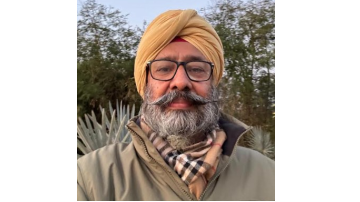
Simplify Gst For The Secondary Steel Sector: Kbs Sidhu Writes To Union Finance Minister After Consulting Mandi Gobindgarh And Khanna Industry
Oct19,2026
| Jagrati Lahar Bureau | Chandigarh / Mandi Gobindga
Former Financial Commissioner Revenue, Punjab, seeks a Group of Ministers or
Committee of Officers for the scrap-based furnaces and rolling mills; cites the High Court's
suggestions of 1 October
After extensive discussions
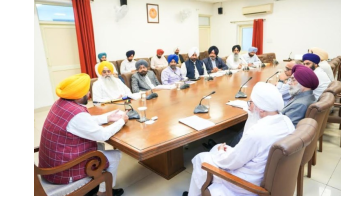
and a brainstorming session with leading members of the industry of Mandi Gobindgarh
and Khanna, KBS Sidhu, former Special Chief Secretary and Financial Commissioner
Revenue, Punjab, has written to Union Finance Minister and GST Council Chairperson
Nirmala Sitharaman, urging that the tax structure of the scrap-based secondary steel
sector be simplified. He has requested that the GST Council examine the sector as a
distinct subject, in keeping with the Prime Minister's emphasis on ease of doing business
and the Finance Ministry's recent approach of taxation based on trust.
The sector comprises the induction furnaces and re-rolling mills of Mandi Gobindgarh,
Khanna and Ludhiana, as distinct from the integrated steel plants that work from mined
iron ore and coking coal. The GST Council, at its 57th meeting on 8 October 2026, has
already recommended the complete withdrawal of the power of arrest from the GST law.
KBS Sidhu said the next step should be a tax design that removes the incentive for fraud
at its source.
The letter, sent this morning, has been copied to the Finance Minister of Punjab, the
Union Revenue Secretary and the Chairman of the Central Board of Indirect Taxes and
Customs.
KBS Sidhu acknowledged at the outset that fake invoicing in the sector is real and
serious, and said his request was not for leniency towards those responsible. "The
question is why this sector, more than most, breeds fake invoices, and whether its tax
design can be changed so that evasion ceases to pay," he said.
He explained that an integrated plant buys ore and coal from a handful of identifiable
suppliers, while a secondary mill buys scrap that passes through many hands: the door-
to-door collector, the kabaria, the trader and at times a financier. "Each link is a point at
which a fictitious firm can issue an invoice. When one defaults, the tax is pursued from
the manufacturer at the end of the chain, who is visible and has a going concern to
protect," he said.
He drew attention to the judgment of the Punjab and Haryana High Court of 1 October
2026, which decided 424 petitions, most of them from steel and scrap units. In
paragraph 104 of the judgment, the Court commended to the Government and the GST
Council an alert on the GST portal when a supplier's registration is being cancelled, real-
time verification by buyers of a supplier's payment of tax, alerts on supplier default,
stricter verification at registration, and reverse charge on scrap from the unorganised
sector.
The letter sets out, without advocating any one of them, the options suggested in the
trade: reverse charge across the whole scrap chain; a lower rate on scrap and secondary
steel; a limit on the number of stages through which input tax credit may pass; and
technology-based verification. It notes that each carries costs, including revenue
implications, which only the Council can weigh.
KBS Sidhu has requested that the Council constitute a Group of Ministers, or direct the
Fitment Committee or a Committee of Officers, to examine the sector exclusively, with
the participation of the States in which it is concentrated and after hearing the industry,
and place its report before the Council's annual meeting on rates.
"A sector that employs many thousands in Punjab, and recycles what would otherwise be
waste, deserves a tax design in which the honest manufacturer does not carry the risk of
the dishonest intermediary, and in which the fraudster finds no profit," he said.
-gst-secondarysteelsector-mandigobindgarh-khannaindustry-kbssidhu










 RSS FEED