4th National Acupuncture Science Congress 2026 Calls For Ayush Recognition, Honours Pioneers And Showcases Scientific Advancements In Acupuncture*
May26,2026
| Jagrati Lahar Bureau | Ludhiana
The 4th National Acupuncture Science Congress (NASC 2026) concluded successfully at Dr. B.R. Ambedkar Bhavan, Vasanth Nagar, Bengaluru, bringing together over 400 delegates from India and abroad, including participants from China, Russia, and Sri Lanka. Organised by the Federation of Acupuncture System of Therapy Board (FAST Board) in association with KUG Oriental Academy, the congress served as a significant platform for scientific exchange, policy dialogue, clinical demonstrations, and institutional advancement in the field of acupuncture.
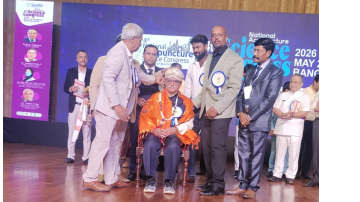
The event witnessed a landmark moment as two distinguished leaders in Indian acupuncture — Dr. Rumi F. Beramji, Administrator of the Maharashtra Council of Acupuncture, and Prof. Dr. Inderjit Singh, recognised as one of the pioneers of acupuncture in India who has just completed a fifty-year journey of Acupuncture-Moxibustion and set up the first indoor hospital in the memory of Dr. Kotnis at Ludhiana — were honoured with the prestigious Mysore Peta, Karnataka’s traditional ceremonial headgear, for their outstanding contributions to the growth and recognition of acupuncture in the country. The felicitation reflected the profession’s growing respect for those who have dedicated decades to strengthening acupuncture education, advocacy, and practice.
A major focus of Dr. Inderjit Singh was the formal recognition of acupuncture under India’s AYUSH framework. Addressing the gathering, Dr. Rumi F. Beramji strongly advocated for acupuncture to be recognised as an independent healthcare discipline rather than being treated as an allied science. He informed delegates that discussions with government authorities are progressing positively and expressed confidence that acupuncture will soon have a dedicated national governing body. He further highlighted the successful model of the Maharashtra Council of Acupuncture, which has introduced structured education, practitioner certification, quality enhancement centres, and accessible examinations for thousands of practitioners across the state.
The congress also featured an encouraging keynote address by Dr. C. Hareesh Babu, Hon’ble Registrar of the Karnataka Ayurvedic and Unani Practitioner Board, Government of Karnataka. Appreciating the progress made by the acupuncture fraternity, he encouraged practitioners and institutions to strengthen research, standardise educational frameworks, and present evidence-based outcomes to policymakers for broader acceptance and formal recognition. He reiterated Karnataka’s openness to developments in alternative healthcare systems backed by scientific evidence.
Adding a personal perspective to the discussions, former Member of Parliament Shri I.G. Sanadi Ji shared his experience of finding relief from chronic asthma through acupuncture after years of conventional treatment. He described acupuncture as an affordable and accessible healthcare option, particularly beneficial for economically disadvantaged sections of society, and called for wider public awareness and policy support for traditional healing sciences.
NASC 2026 featured an extensive scientific programme with research presentations and live clinical demonstrations across multiple specialisations. Experts Dr inderjit singh,Dr Sandeep chopra,Dr ummar ,Dr Samullas,Dr behram and Dr neelesh discussed acupuncture’s applications in vision improvement, oncology, obesity management, aphasia, and neurological disorders. Dr. Inderjit Singh shared his experiences on allergic rhinitis and post-COVID complications. Dr. Neelesh Patel also presented on obesity management. Live demonstrations and patient case studies highlighted acupuncture’s growing evidence base and practical relevance in integrative healthcare. Among the notable sessions, Prof. Dr. A.R. Samiullah presented successful outcomes in treating aphasia through acupuncture, while Dr. Shi Meiyan from China spoke on integrative oncology and the role of Traditional Chinese Medicine in cancer care.
International delegates from Sri Lanka, Russia, and China praised India’s growing acupuncture ecosystem and expressed optimism about future collaborations to strengthen global acceptance and scientific advancement of acupuncture. Their participation highlighted the increasing international recognition of India’s efforts in developing acupuncture as a credible healthcare system.
The 4th National Acupuncture Science Congress 2026 concluded with a collective commitment to advancing acupuncture through scientific research, quality education, ethical practice, and policy reform.
4th-National-Acupuncture-Science-Congress-2026-Calls-For-Ayush-Recognition










 RSS FEED