




1984 was an organized slaughter led by Congress workers, not a Hindu–Sikh clash
Phoolka challenges Sonia Gandhi to name a single violent incident in Delhi on October 31 afternoon
Chandigarh, November 11
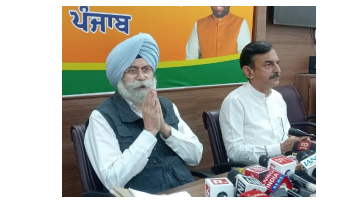
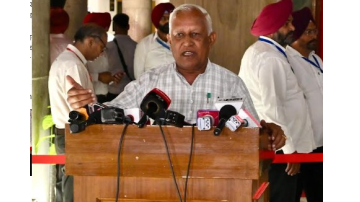
Senior Advocate H.S. Phoolka, who has waged a four-decade-long legal battle for the victims of the 1984 anti-Sikh massacre, addressed the media in Chandigarh today, repudiating the claims made in Sonia Gandhi’s newly released memoir, ‘Belonging: A Journey of Love’. Phoolka termed the book a calculated attempt to twist historical facts, mislead the public, and provide an unwarranted clean chit to Rajiv Gandhi and the Gandhi family.
Addressing reporters, Phoolka, who was accompanied by state media head Vineet Joshi, stated that the narrative being pushed through the memoir seeks to revive the false claim that the 1984 violence was a spontaneous "Hindu versus Sikh" conflict arising from public anger.
Congress Worker Targeted Sikhs
"It was neither a spontaneous riot nor a Hindu–Sikh clash," Phoolka asserted, adding that ordinary Hindus did not kill Sikhs; it was Congress workers, engineered mobs, and organized elements affiliated with the party who systematically targeted innocent Sikhs while law enforcement looked away.
He said that what happened was not just the brutal murder of thousands of innocents, but the premeditated murder of justice, the rule of law, and the Constitution.
Phoolka directly challenged Sonia Gandhi to cite even a single incident of public unrest or communal violence in Delhi during the afternoon of October 31, 1984, immediately after Indira Gandhi was shot.
"The memoir attempts to create a myth that common citizens flew into an uncontrollable rage across the capital the moment the news broke,” he said, adding that in reality, the city was peaceful that entire afternoon. "The violence began only around 5:00 PM, orchestrated by organized goons who ambushed the motorcade of President Giani Zail Singh outside AIIMS. That attack marked the start of a pre-planned political operation, not an organic popular eruption."
2000 Sikhs Could have been saved
Phoolka also took strong exception to Sonia Gandhi's claims shifting the blame for the delayed military deployment onto then-Chief of Army Staff General A.S. Vaidya. In her book, Sonia Gandhi claims that Rajiv Gandhi asked General Vaidya on the night of October 31 to summon the Army, but the Army Chief hesitated because units near Delhi contained Sikh soldiers, opting instead to call troops from distant stations like Dehradun.
Phoolka dismissed this claim as factually untenable and an insult to military history. Citing official Justice Misra Commission records and sworn testimonies of senior military officers, Phoolka clarified that an Army Chief's constitutional role is solely to make armed units available upon formal requisition; actual deployment, sector allocation, and issuing shoot-at-sight orders rest entirely with the civil administration.
"Official commission records confirm that nearly 6,000 trained troops were already present and available in Delhi between the night of October 31 and the morning of November 1," Phoolka said. "They were deliberately kept confined to cantonment barracks while Delhi was left to burn. Had the civil administration deployed these available forces on the streets without criminal delay, more than 2,000 innocent Sikh lives could have been saved."
Issue an unconditional public apology
Phoolka questioned why, if Rajiv Gandhi bore no responsibility, his administration failed to take action against a single police or civil officer who delayed the deployment. Instead, leaders and officials named by victims were rewarded with parliamentary tickets, ministerial berths, and promotions. He added that Rajiv Gandhi’s infamous remark—"when a big tree falls, the earth shakes"—was an explicit justification of the genocide.
Demanding accountability, Phoolka stated that historical truth must be tested against judicial commission records, inquiry files, and contemporaneous evidence rather than self-serving political memoirs. He demanded that Sonia Gandhi either place verifiable documentary evidence on record or issue an unconditional public apology for peddling falsehoods.






Jagrati Lahar is an English, Hindi and Punjabi language news paper as well as web portal. Since its launch, Jagrati Lahar has created a niche for itself for true and fast reporting among its readers in India.
Gautam Jalandhari (Editor)



 RSS FEED